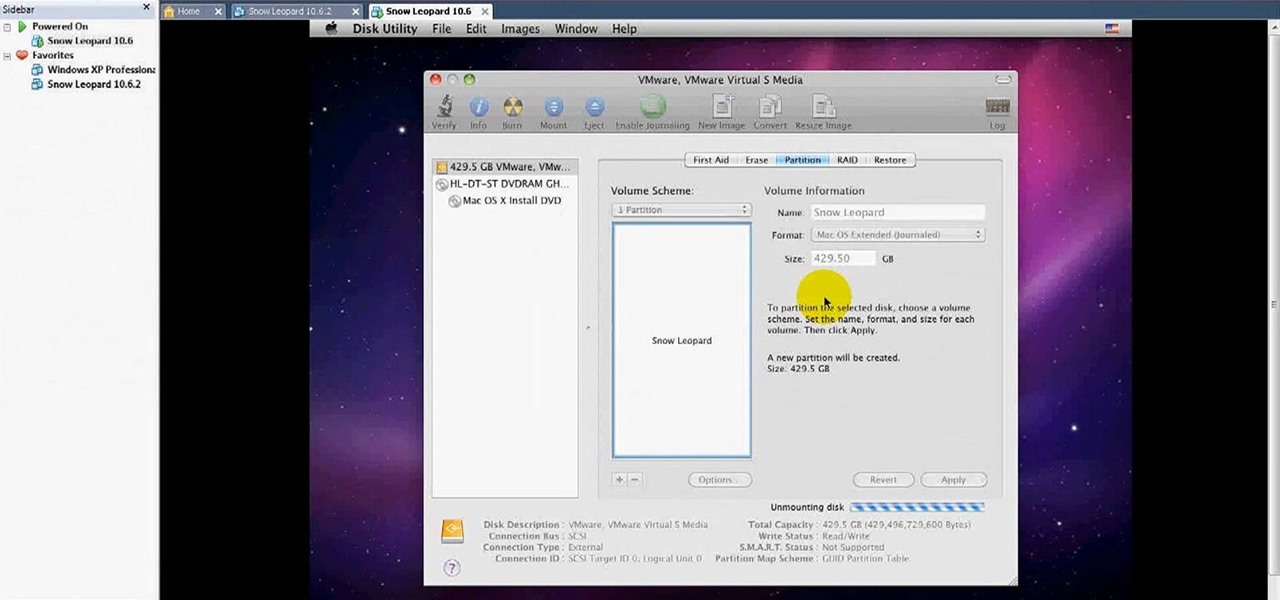
MacOSX Snow Leopard 10.6.2.0 For VmWare (2010)-included
The following step by step guide will help you in installing Mac OS X 10.6 Snow Leopard as a guest virtual machine in Windows 7. You’ll need to have a system with an Intel processor which supports hardware virtualization, original OS X Snow Leopard retail disk, VMware Workstation 7 and Windows 7, Vista or XP installed as host operating system. If you meet all these requirements, you can then install OS X Snow Leopard in VMware under Windows and can enjoy the best of both worlds.
Note: We don’t in anyway encourage downloading Apple software via file-sharing / torrent sites and run it in an virtualized environment under Windows. This guide is for informational purposes only. If you like OS X Snow Leopard, Get a Mac.
Avira Premium Security Suite 9.0.0.384 including Keys patch :-( Windows 7. New serial crack 8-((( MacOSX Snow leopard 10.6.2.0 for VmWare (2010) keygen. 90029 Microsoft Office 2010 Professional Plus RTM ( x86/x64)-ESCROW. Download Perfectsetup For Xp Sp3 Aug 2010 keygen serial number here. HD,MacOSX Snow leopard 10.6.2.0 for VmWare (2010)-included,.
Step 1: Download and install VMware Workstation 7.
Step 2:Click here to download pre-made modified version of Snow Leopard.vmdk and darwin_snow.iso files required to get this thing to work.
Step 3: Start VMware Workstation and open up “Mac OS X Server 10.6 (experimental).vmx” file which you downloaded in Step 2.
Step 4: Click on “Edit virtual machine settings”, select CD/DVD (IDE) option from left hand side and then and select “Use ISO image file” option. Point it to “darwin_snow.iso” which you downloaded in Step 2.
Step 5: Now power on the virtual machine and hit “F8” key. You should now have a screen similar to the one shown below.
Step 6: Now you’ll have to point your virtual machine to OS X Snow Leopard retail DVD instead of “darwin_snow.iso”. To do this, right click on CD/DVD option found in lower right most corner of your VMware window and select settings.
Insert OS X Snow Leopard retail DVD in your DVD drive and select the “Use physical drive” option.
Step 7: Now go back and select “c” option (Boot DVD) from the prompt which you got in Step 5 to boot from the OS X retail DVD. OS X boot screen with Apple logo should now appear. If the boot screen doesn’t appear for you, try booting it in verbose mode by pressing “F8” key after selecting “c” option, and then enter “-v” (without quotes). This will enable the system to boot OS X DVD using verbose mode.
Step 8: Wait for a couple of minutes for the Installation Setup screen to show up. From here on, simply follow the onscreen setup instructions to install OS X Snow Leopard. Make sure you format your virtual hard drive in “Mac OS Extended (Journaled)” format using Disk Utility. Customize your installation with minimum set of printer drivers and language options for a lightweight trouble free installation experience.

Step 9: Once the installation is completed. System will automatically reboot. At this point, close your guest virtual machine and change your CD/DVD option again like you did in Step 2 to point it to “darwin_snow.iso”. Picroma plasma 1 0 download speed.
Step 10: Start the virtual machine again. Press “F8” key and select “h” option to “Boot first hard disk”. Voila! Snow Leopard should now be running live under Windows 7!
Related posts:
VirtualBox is a powerful x86 virtualization product for enterprise as well as home use. Not only is VirtualBox an extremely feature rich, high performance product for enterprise customers, it is also the only professional solution that is freely available as Open Source Software under the terms of the GNU General Public License (GPL).
Presently, VirtualBox runs on Windows, Linux, Macintosh and OpenSolaris hosts and supports a large number of guest operating systems including but not limited to Windows (NT 4.0, 2000, XP, Server 2003, Vista, Windows 7), DOS/Windows 3.x, Linux (2.4 and 2.6), Solaris and OpenSolaris, and OpenBSD.
VirtualBox Features
- 64-bit guests (64 bit hosts with CPU virtualisation extensions or experimentally on 64bit capable 32bit host operating systems)
- NCQ support for SATA raw disks and partitions
- Snapshots
- Seamless mode
- Clipboard
- Shared folders
- Special drivers and utilities to facilitate switching between systems
- Experimental OpenGL drivers for win32 and Linux to render on Host hardware
- Command line interaction (in addition to the GUI)
- Public API (Java, Python, SOAP, XPCOM) to control VM configuration and execution [16]
- Remote display (useful for headless host machines)
- Nested paging for AMD-V and Intel Core i7
- Raw hard disk access - allows a guest operating system to access its virtual hard disk without going through the host OS file system
- VMware Virtual Machine Disk Format (VMDK) support - allows VirtualBox to use a disk image created in VMware
- Microsoft VHD support