Download Aircheck Wifi Tester For Mac
NetSpot is the only professional app for wireless site surveys, Wi-Fi analysis, and troubleshooting on Mac OS X and Windows. It's a FREE Wi-Fi analyzer. No need to be a network expert to improve your home or office Wi-Fi today! All you need is your MacBook running Mac OS X 10.10+ or any laptop with Windows 7/8/10 on board and NetSpot which. The NETSCOUT AirCheck G2 wireless tester is a powerful tool designed to enable front-line IT to quickly and easily identify issues responsible for spotty connections, dead zones, and slow speeds, as well as locating rogue access points and unauthorized devices. This functionality is ideal to support installation and troubleshooting of IoT.
Because of their wireless nature, WiFi networks have many vulnerabilities. For example, an unauthorized person can access the network if such a person gets the password to the WiFi network. Such vulnerabilities can cause security threats to the other computers using the network.
Then click OK.A Juno plugin named org.eclipse.jetty.server.jar conflicts with the MTJ libraries when the plugin version is higher than 6.If the org.eclipse.jetty.server version is higher than 6 you must prevent it from loading by changing its name so the JAR file is not parsed. Locate the file in the plugins directory of your Juno installation and change the extension from.jar to something else.For example, change it to: org.eclipse.jetty.server. Checkbox and click Next.On the installation screen select all plugins and click Finish. The MTJ is not bundled with Juno and must be installed manually, before installing the Eclipse plugins.To install the Eclipse Mobile Tools for Java toolkit:.Go to Help Install New Software.In the “Work with” field, enter this URL:.Click Add.When the plugins are discovered, open the Mobile and Device Development Tools hierarchy and check Mobile Tools for Java Examples and Mobile Tools for Java SDK.Uncheck the 'Contact all update sites.' How to install eclipse on mac 2019.
Moreover, these vulnerabilities can also affect the internet connection speed on the network as the intruders use up bandwidth. WiFi WPS WPA Tester is an application that allows the user to monitor activity on their WiFi network so as to recognize any vulnerability that may exist in the network.
List of Contents
Features of WIFI WPS WPA TESTER
WiFi WPS WPA Tester has several features which makes it the best app for use in monitoring a WiFi network. Firstly, the application allows users to recognize any unauthorized access to the WiFi network. The app does this by determining whether the WPS protocol on the WiFi network has any vulnerabilities. Secondly, WiFi WPS WPA Tester also allows users to view all the passwords that they connect to using the device running the Tester.
WIFI WPS WPA TESTER for PC
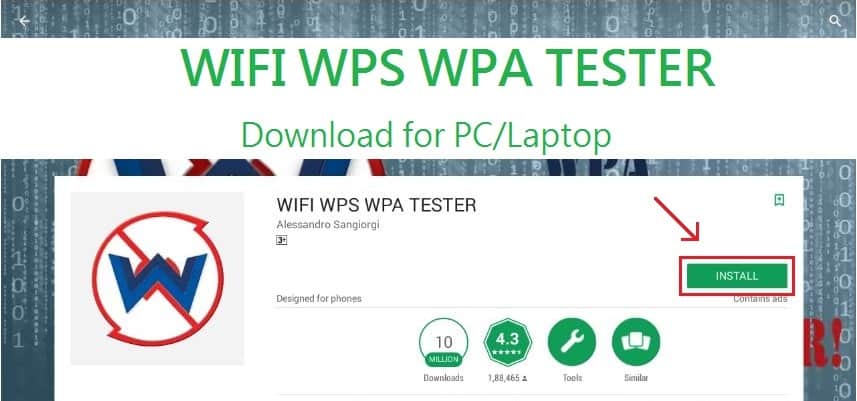
Unfortunately, WiFi WPS WPA Tester is currently only available for android devices. However, users can run the tester on their personal computers using the BlueStacks emulator. This is a software that creates a virtual android machine on your personal computer allowing you to run android applications on the PC.
Installing WiFi WPS WPA Tester for Windows
- Download BlueStacks from the official site and install the emulator on the PC running windows. BlueStacks can be installed on Windows XP, Windows 7, Windows 8, Windows 8.1 and Windows 10
- After the installation is complete, run BlueStacks on your PC and open Google Play Store on the emulator.
- In Google Play Store, search for WiFi WPS WPA Tester
- Download the apk file for the Tester and install it through the emulator.
- After installation is complete, the WiFi WPS WPA Tester icon appears in the emulator.
- Click the icon and follow the onscreen instructions to run WiFi WPS WPA Tester on you PC.
It is important to note that WiFi WPS WPA TESTER will only run on the personal computer when the BlueStacks emulator is open. Therefore, you should ensure that you run all the browsers on the computer through BlueStacks emulator to ensure a secure WiFi connection.
- How To Use Amaziograph On Windows 10, 8, 7 PCs - May 11, 2020
- IP Webcam For PC, Windows And Mac – Free Download - May 11, 2020
- Download and Install Keepsafe App on your PC Laptop - May 8, 2020
If you've followed the steps to connect your Mac to a Wi-Fi network, but the connection to your network or the Internet isn't reliable, the steps in this article might help.
Check for Wi-Fi recommendations
When your Mac tries to connect to a Wi-Fi network, it checks for issues that affect its ability to create a fast, stable, and secure connection. If an issue is detected, the Wi-Fi status menu in the menu bar shows a new item: Wi-Fi Recommendations. Choose it to see recommended solutions.
Wi-Fi recommendations are available in macOS Sierra or later.
Analyze your wireless environment
Your Mac can use Wireless Diagnostics to perform additional analysis.
- Quit any apps that are open, and connect to your Wi-Fi network, if possible.
- Press and hold Option (Alt) ⌥ key, then choose Open Wireless Diagnostics from the Wi-Fi status menu .
- Enter your administrator name and password when prompted.
Wireless Diagnostics begins analyzing your wireless environment:
If the issue is intermittent, you can choose to monitor your Wi-Fi connection:
When you're ready to see recommendations, continue to the summary. Wireless Diagnostics asks for optional information about your base station or other router, so that it can include that in the report it saves to your Mac.
Click the info button next to each item in the summary to see details about that item. Wi-Fi best practices are tips that apply to most Wi-Fi networks.
Back up or make note of your network or router settings before changing them based on these recommendations—in case you need to use those settings again.
Monitor your Wi-Fi connection
Your Mac can monitor your Wi-Fi connection for intermittent issues, such as dropped connections. Follow the steps to analyze your wireless environment, but choose ”Monitor my Wi-Fi connection” when prompted.
During monitoring, a window shows that monitoring is in progress. Monitoring continues as long as this window is open and you're on the same Wi-Fi network, even when your Mac is asleep.
If Wireless Diagnostics finds an issue, it stops monitoring and shows a brief description of the issue. You can then resume monitoring or continue to the summary for details and recommendations.
Create a diagnostics report
Wireless Diagnostics automatically saves a diagnostics report before it displays its summary. You can create the same report at any time: press and hold the Option key, then choose Create Diagnostics Report from the Wi-Fi status menu . It can take your Mac several minutes to create the report.
- macOS Sierra and later saves the report to the /var/tmp folder of your startup drive, then opens that folder for you.
To open the folder manually, choose Go > Go to Folder from the Finder menu bar, then enter /var/tmp. - OS X El Capitan or earlier saves the report to your desktop.
The report is a compressed file with a name that begins “WirelessDiagnostics.” It contains many files that describe your wireless environment in detail. A network specialist can examine them for further analysis.
Use other diagnostics utilities
Wireless Diagnostics includes additional utilities for network specialists. Open them from the Window menu in the Wireless Diagnostics menu bar:
- Info gathers key details about your current network connections.
- Logs enables background logging for Wi-Fi and other system components. The result is saved to a .log file in the diagnostics report location on your Mac. Logging continues even when you quit the app or restart your Mac, so remember to disable logging when you're done.
- Scan finds Wi-Fi routers in your environment and gathers key details about them.
- Performance uses live graphs to show the performance of your Wi-Fi connection:
- Rate shows the transmit rate over time in megabits per second.
- Quality shows the signal-to-noise ratio over time. When the quality is too low, your device disconnects from the Wi-Fi router. Factors that affect quality include the distance between your device and the router, and objects such as walls that impede the signal from your router. Learn more.
- Signal shows both signal (RSSI) and noise measurements over time. You want RSSI to be high and noise to be low, so the bigger the gap between RSSI and noise, the better.
- Sniffer captures traffic on your Wi-Fi connection, which can be useful when diagnosing a reproducible issue. Select a channel and width, then click Start to begin capturing traffic on that channel. When you click Stop, a .wcap file is saved to the diagnostics report location on your Mac.
Learn more
Additional recommendations for best Wi-Fi performance:
- Keep your router up to date. For AirPort Time Capsule, AirPort Extreme, or AirPort Express Base Station, check for the latest firmware using AirPort Utility. For non-Apple routers, check the manufacturer's website.
- Set up your router using Apple's recommended settings, and make sure that all Wi–Fi routers on the same network use similar settings. If you're using a dual-band Wi-Fi router, make sure that both bands use the same network name.
- Learn about potential sources of Wi-Fi and Bluetooth interference.
Learn about other ways to connect to the Internet.