
How To Plot Xbar And R Bar Chart In Excel
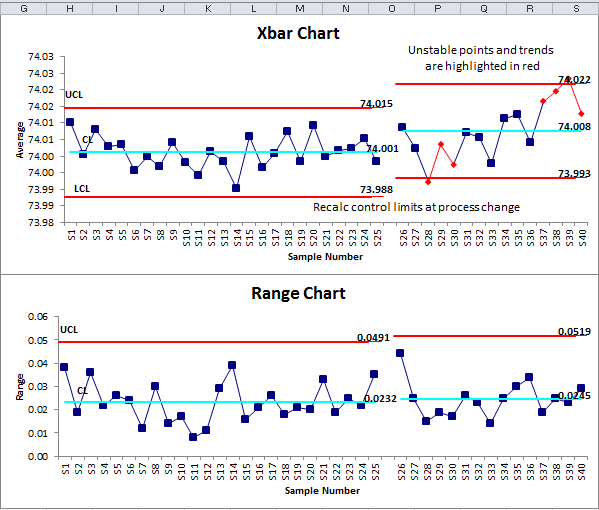
Beside=T tells R to plot the bars, well, beside each other. (Try it without this argument and watch what happens.) ylim insures that no bar will rise above the highest value on the y-axis. Col=color.names supplies the colors named in the vector. The plot isn’t complete without the legend (the box that tells you which plot colors correspond to. Xbar-R Charts for a Single Characteristic. Traditionally, an Xbar-R chart is used to plot a subgroup mean for smaller subgroups and the range of individual values for a single characteristic. For example, this chart (taken from InfinityQS ® ProFicient ™ software) plots data for 20 subgroups. The highlighted section shows that the average value for subgroup 8 is well within control limits.
You’ve probably seen bar plots where each point on the x-axis has more than one bar. The image below shows an example. The bar plot shows the frequency of eye color for four hair colors in 313 female students. The data is from the HairEyeColor data set. This type of plot is called a grouped bar plot.
How does the base R graphics package deal with that? You begin by isolating the female data in the HairEyeColor data set, which lives in the datasets package:
To begin producing the image above, you have to specify the colors in the bars and in the legend:
> color.names = c('black','grey40','grey80','white')
A word about those names: You can combine grey with any number from 0 to 100 to create a color — “grey0” is equivalent to “black” and “grey100” is equivalent to “white”.
Now you turn once again to the barplot() function. Interestingly, if you use females as the first argument for barplot(), R draws a plot with Eye Color on the x-axis (rather than Hair Color). To reverse that, you use t() to interchange (transpose, in other words) the rows and columns:
The function that produces the bar plot is
Installation guide sap gui 7 40 java for mac. SAP GUI FOR WINDOWS. SAP Frontend Components. By Category.
beside=T tells R to plot the bars, well, beside each other. (Try it without this argument and watch what happens.) ylim insures that no bar will rise above the highest value on the y-axis. col=color.names supplies the colors named in the vector.
The plot isn’t complete without the legend (the box that tells you which plot colors correspond to which eye colors):
> legend('top',rownames(t(females)),cex =0.8,fill=color.names,title='Eye Color')
The first argument puts the legend at the top of the plot, and the second argument provides the names. The third argument specifies the size of the characters in the legend — .08 means “80% of the normal size.” The fourth argument gives the colors for the color swatches, and the fifth, of course, provides the title.